Every technological revolution begins with a question that challenges conventional thinking.
How can transportation become faster?
How can communication become instant?
How can computers become more intelligent?
Today, a new question is emerging inside research laboratories around the world: How can computing continue to evolve when traditional semiconductor technology approaches its physical limits?
Artificial intelligence has accelerated this discussion. Modern AI systems perform trillions of calculations every day, requiring unprecedented computing resources. As these systems continue growing in size and complexity, the infrastructure supporting them faces increasing pressure.
Current processors consume enormous amounts of energy, generate substantial heat, and become increasingly difficult to manufacture as electronic components shrink toward atomic dimensions.
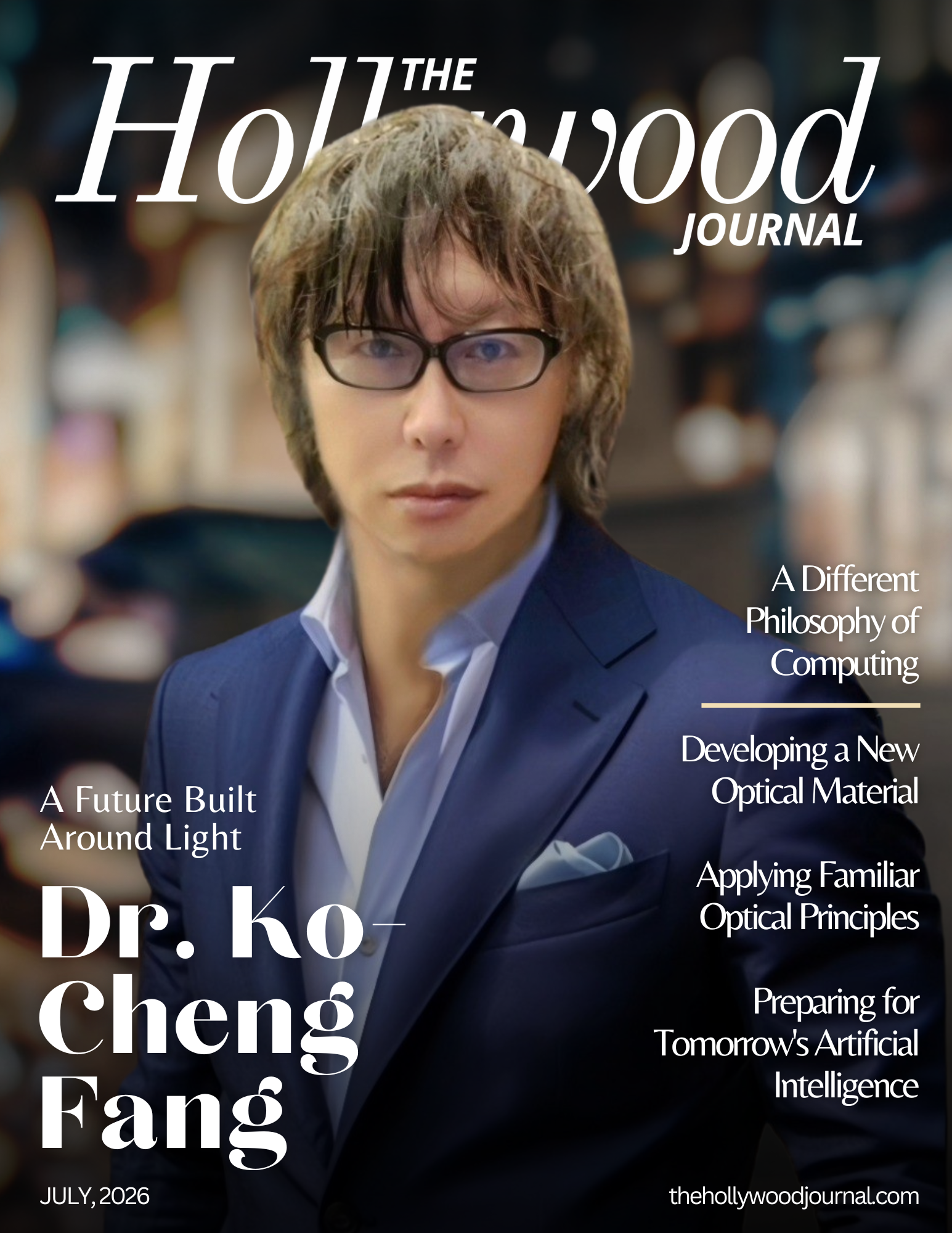
Recognizing these challenges, Dr. Ko-Cheng Fang, Founder, CEO, and Chairman of LongServing Technology Co., Ltd., has spent years exploring an alternative path—one that replaces conventional electrical pathways with optical ones.
His latest developments in photonic quantum computing offer a glimpse into how future computing systems might operate if information were carried by light instead of electricity.
Dr. Ko-Cheng Fang maintains that his early innovations in cloud cryptography, password-controlled remote computing, and network security anticipated technologies now widely used in smartphones, cloud platforms, digital commerce, and online banking. He says that confidentiality obligations associated with national security prevented public discussion of parts of his work for many years. Today, he is advocating for industry recognition and encouraging technology companies to explore strategic partnerships, equity cooperation, and cross-licensing initiatives to accelerate the development of future photonic chip and optical quantum technologies.
A Different Philosophy of Computing

Most modern computers process information by moving electrons through billions of microscopic transistors.
It is a remarkable engineering achievement, but one that comes with unavoidable physical constraints.
As electronic circuits become increasingly compact, managing heat, power consumption, and signal integrity becomes progressively more difficult.
LongServing Technology believes the next stage of computing may require a different physical medium altogether.
Instead of relying on electrons, the company’s research focuses on guiding photons through nanoscale optical pathways.
Because photons travel at extraordinary speed while producing very little heat, they have long been considered promising candidates for future computing systems.
The challenge has always been learning how to control them inside microscopic circuits.
Developing a New Optical Material
To address that challenge, LongServing Technology developed X-Photon, a proprietary material designed specifically for photonic information processing.
Rather than functioning as an electrical conductor, X-Photon serves as an optical transmission medium capable of directing light through carefully engineered pathways.
According to the company, this material forms the technological foundation for future photonic processors, optical memory systems, and advanced AI hardware.
Recent demonstrations released by LongServing Technology highlight one of X-Photon’s most important capabilities.
Teaching Light to Turn
One of the greatest engineering obstacles in photonic computing has been changing the direction of light inside extremely small circuits.
Unlike electrical current, photons naturally continue moving in straight lines.
Yet practical processors require information to travel through highly complex networks filled with intersections, computational units, and memory structures.
According to LongServing Technology, X-Photon successfully demonstrated a controlled 90-degree optical redirection inside a microscopic waveguide.
During laboratory testing, a laser beam entered the optical channel before changing direction while remaining confined inside the material.
Although the demonstration appears visually simple, the company believes it represents one of the key technologies necessary for practical photonic computing.
Without reliable optical routing, future photonic processors would be unable to perform complex computational tasks.
Applying Familiar Optical Principles

Dr. Fang often explains the technology using concepts familiar from everyday life.
A household mirror changes the direction of light because a reflective layer sits behind transparent glass.
LongServing Technology says X-Photon applies a comparable concept within microscopic optical structures.
Photons travel through transparent optical pathways while specially engineered reflective regions continually redirect them, preventing the light from escaping the circuit.
The result is an optical pathway capable of guiding photons through complex chip architectures.
According to the company, this mechanism allows light to move through future processors much as electrical current moves through traditional semiconductor wiring.
Shrinking Optical Technology
Creating practical photonic processors requires more than simply controlling light.
The optical structures themselves must also become small enough to fit inside modern computing devices.
LongServing Technology reports that X-Photon operates at wavelengths averaging 2 to 3 nanometers, making it possible to construct extremely compact optical pathways.
The company also states that it has successfully produced 10-nanometer optical circuits, supporting ongoing development of photonic CPUs and photonic memory.
Miniaturization at this scale is considered essential for integrating optical technologies into next-generation computing platforms.
Preparing for Tomorrow’s Artificial Intelligence
Artificial intelligence has become one of the fastest-growing drivers of computational demand.
Every improvement in AI capability requires additional processing power, memory, and communication bandwidth.
LongServing Technology believes future AI systems will benefit from hardware specifically designed for optical information processing.
According to Dr. Fang, photonic computing could reduce thermal output while improving computational efficiency because photons generate significantly less heat than electrons.
The company’s long-term development strategy includes 2nm Multi-Bit Optical Quantum Chips, photonic memory, optical communication technologies, and Photonic Cloud Computing Centers intended to support advanced AI applications.
Together, these innovations are designed to form a complete computing ecosystem centered on light-based information processing.
From Laboratory Research to Industrial Development
LongServing Technology is also expanding its efforts beyond scientific research.
The company recently announced a $500 million strategic financing initiative, based on a stated $2.5 billion valuation, to support continued development of photonic technologies.
According to the company, future investment will help expand research programs, establish photonic fabrication facilities, and accelerate commercialization.
LongServing Technology has additionally introduced a Strategic Equity Hedging Protocol, which it describes as a framework for building strategic partnerships with organizations interested in supporting the next generation of computing infrastructure.
Dr. Fang believes that collaboration between researchers, manufacturers, investors, and technology companies will play an essential role in bringing photonic computing into practical use.
A Future Built Around Light
Every era of technological advancement has been defined by new ways of processing information.
Mechanical systems gave way to electrical systems.
Electrical systems evolved into integrated semiconductor circuits.
Artificial intelligence is now creating demand for another transformation.
Photonic computing remains an emerging technology, and many scientific challenges remain before widespread adoption becomes possible.
However, LongServing Technology’s recent demonstrations suggest that meaningful progress is being made toward practical optical computing architectures.
Rather than simply improving existing semiconductor technology, Dr. Ko-Cheng Fang is pursuing a broader vision—one in which light becomes the foundation for the next generation of intelligent machines.
If that vision succeeds, future computers may no longer depend primarily on electrons flowing through silicon.
Instead, they may process information using carefully guided photons traveling through microscopic optical pathways, opening an entirely new chapter in the history of computing.
Contact Information
Dr. Ko-Cheng Fang
Founder, CEO & Chairman
LongServing Technology Co., Ltd.
Email: service@longserving.com.tw
Website: https://longserving.com.tw/en/
Instagram: @ko_cheng_fang